Executive Summary
- Who this is for: CIOs, CTOs, Enterprise Architects, Architecture Leaders
- Problem it solves: Confusion between Enterprise, Solution, and Technical Architect roles leading to blurred accountability and architectural instability
- Key outcome: Clear responsibility boundaries aligned to business geography
- Time to implement clarity: 30 days with structured role alignment
- Business impact: Reduced architectural friction, stronger governance, improved execution predictability
Snow, Sand, and Architectural Roles
Imagine designing a building in a region where snow reaches three meters every winter.
If the roof is flat, it collapses.
Now imagine moving the same blueprint to a desert climate.
Cooling systems overload. Energy costs surge.
In tropical humidity, corrosion spreads.
The same design cannot survive all environments.
Architecture must adapt to geography.
In Context-Driven Architecture, we established that software must align with business geography.
But this raises a critical question:
Who decides the climate?
Who designs the building?
Who selects the materials?
That is the difference between Enterprise, Solution, and Technical Architects.
The Context-Driven Lens
Business geography consists of:
- Business Climate (volatility)
- Organizational Terrain (maturity)
- Economic Temperature (cost sensitivity)
- Growth Geography (lifecycle stage)
Each architectural role responds to geography at a different altitude.
Understanding this separation prevents structural confusion.
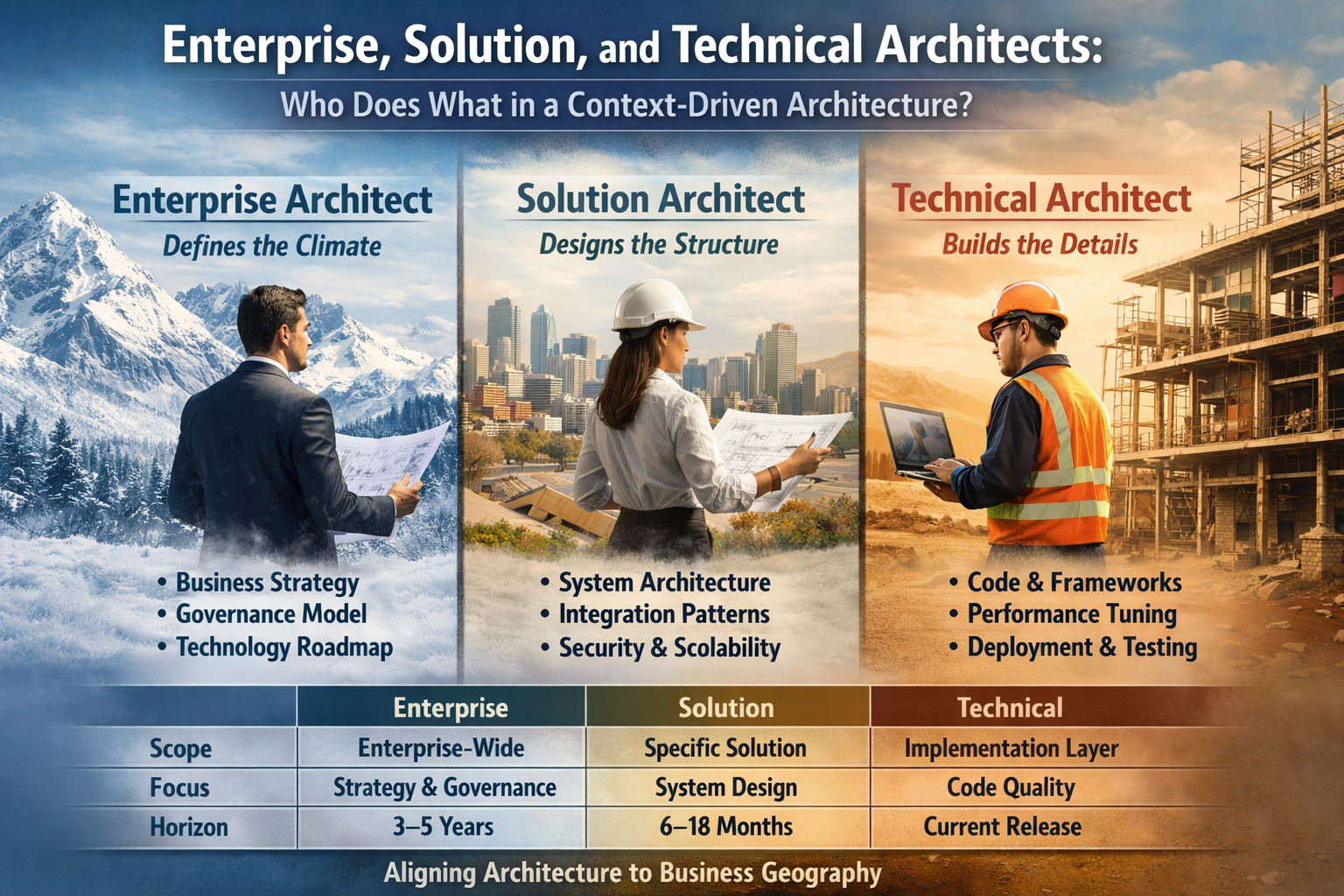
1. Enterprise Architect — The Environmental Strategist
Enterprise Architects operate at the environmental level.
They define:
- Target operating model
- Capability map
- Technology principles
- Platform strategy
- Governance structure
- Buy vs build posture
- Cloud and AI positioning
They answer:
“Given our business geography, what structural patterns should we adopt?”
They do not design APIs.
They do not choose frameworks.
They do not debate code structure.
They define the climate constraints.
In the Snow Example
The Enterprise Architect determines:
- This region has heavy snowfall
- Roofs must be sloped
- Load-bearing standards must increase
- Insulation budget is justified
They do not design the roof.
They define the environmental rules.
Risk of Failure
If Enterprise Architecture misreads geography:
- Microservices are adopted in stable environments
- Event streaming is forced without volatility
- AI autonomy expands without governance
Strategic misalignment occurs.
2. Solution Architect — The Structural Designer
What They Actually Do
Solution Architects operate within enterprise guardrails.
They design specific systems and initiatives.
They define:
- Service boundaries
- Integration patterns
- Data flows
- Security patterns
- Resilience mechanisms
- Technology selection within policy
They answer:
“How do we design this system correctly within our geography?”
They interpret volatility and maturity for a specific program.
In the Snow Example
Enterprise Architect says:
“This is a heavy snow region.”
Solution Architect says:
“For this specific building we need:
- 45-degree roof pitch
- Reinforced beams
- Drainage channels
- Snow load calculations”
They translate environment into structure.
Risk of Failure
If Solution Architects ignore enterprise constraints:
- Duplicate platforms emerge
- Integration sprawl increases
- Governance weakens
- Structural inconsistency spreads
Instability follows.
3. Technical Architect — The Material Engineer
What They Actually Do
Technical Architects operate at execution depth.
They focus on:
- Framework selection
- Code structure
- Performance tuning
- CI/CD alignment
- Observability implementation
- Runtime reliability
- Security hardening
They answer:
“How do we build this correctly at the implementation level?”
They ensure structural integrity.
They do not redefine climate.
They do not redefine enterprise strategy.
They ensure execution quality.
In the Snow Example
They decide:
- Steel grade
- Joint reinforcement
- Waterproof membrane
- Load-bearing testing
- Structural validation
They ensure the roof does not fail.
Risk of Failure
If Technical Architecture is weak:
- Technical debt accumulates
- Performance degrades
- Observability gaps emerge
- Systems become fragile
Implementation instability appears.
Why Organizations Struggle
Role confusion creates structural collapse.
Common patterns:
- Enterprise Architect debates framework selection
- Solution Architect redefines enterprise cloud posture
- Technical Architect challenges operating model
- No one owns contextual alignment
When accountability blurs, geography is ignored.
And architecture collapses under invisible load.
Clear Responsibility Comparison
| Dimension | Enterprise Architect | Solution Architect | Technical Architect |
|---|---|---|---|
| Scope | Enterprise-wide | Initiative / Program | Implementation Layer |
| Time Horizon | 3–5 years | 6–18 months | Current release cycle |
| Primary Focus | Structural Fit | System Blueprint | Engineering Integrity |
| Owns | Principles & Governance | Architecture Design | Code & Runtime Quality |
| Risk Type | Strategic Misalignment | Structural Instability | Technical Debt & Fragility |
Each role is critical.
They operate at different altitudes.
Implementation Guide (30 Days)
Phase 1: Role Clarification (Weeks 1–2)
- Document architectural role definitions
- Define decision boundaries
- Align reporting lines
- Clarify escalation pathways
Success Metric: No architectural decision without a clearly accountable role
Phase 2: Governance Alignment (Weeks 3–4)
- Map ADR ownership by role
- Separate strategic, structural, and implementation decisions
- Introduce cross-role review checkpoints
Success Metric: Reduced architectural friction and faster decision cycles
Final Thought
Enterprise Architects define the climate.
Solution Architects design the structure.
Technical Architects ensure structural integrity.
When roles blur, geography is ignored.
When geography is ignored, architecture collapses.
Respect context.
Respect roles.
Respect structural boundaries.
Architecture is not hierarchy.
It is layered responsibility aligned to environment.
Next Step
If your organization struggles with architectural role clarity or structural misalignment:
→ Book a 30-minute strategy consultation
Context-driven clarity begins with role discipline.